Sunday, February 10, 2013
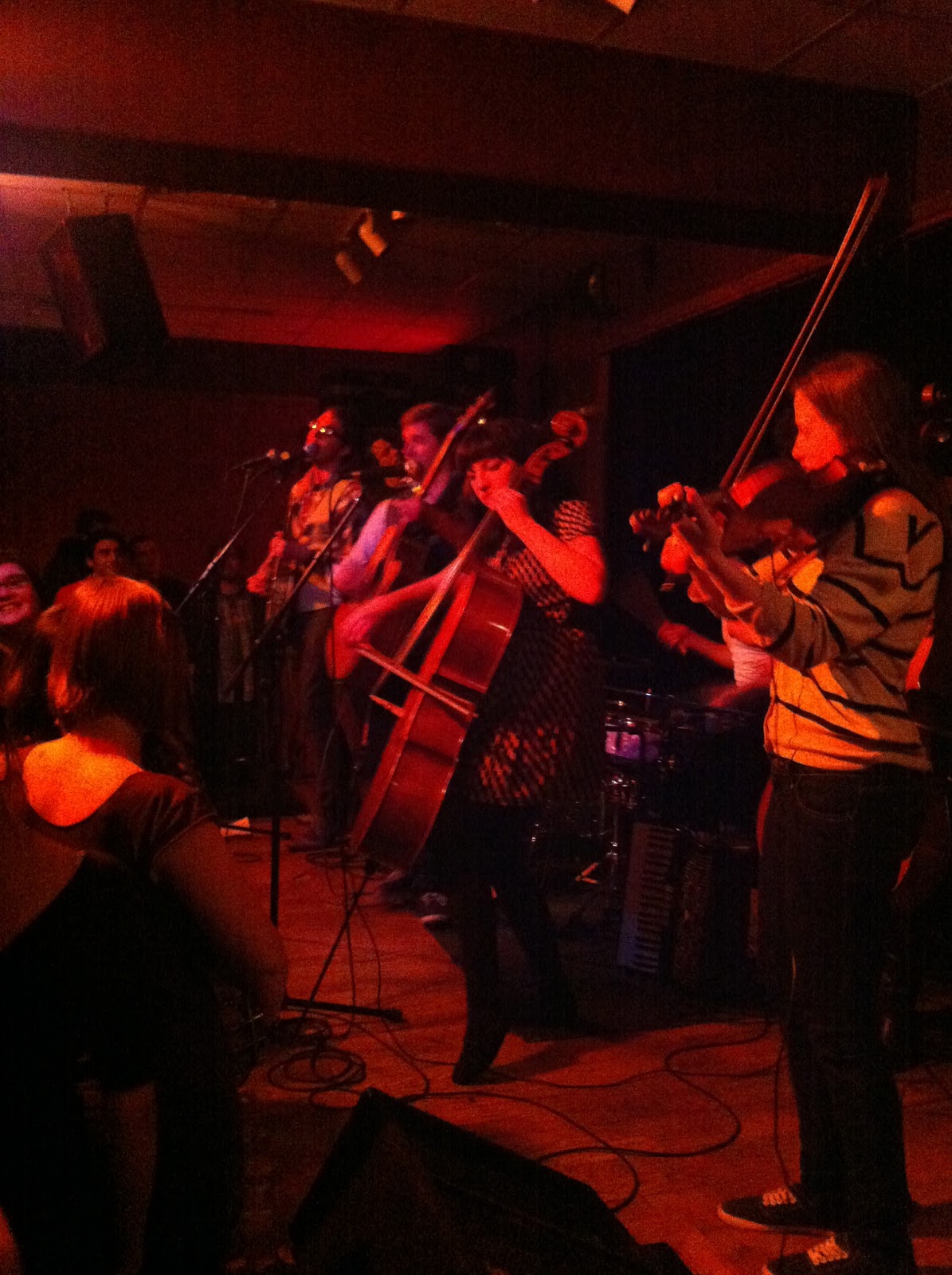
The Seedy Seeds, The Ridges and Alex Miller / February 7, 2013 / Casa Cantina
Monday, September 24, 2012
Frame Family Band and Fresh Wreckage / Donkey Coffee / September 21, 2012
Sunday, June 3, 2012
ACRN Lobsterfest 2012 / Day Two / June 1 / Casa Cantina
Sunday, May 13, 2012
UCM Benefit Show / May 11, 2012 / Donkey Coffee
Photo from: Better Together
Earth Day was held once again this year at Donkey as an Americorps/UCM fundraising concert for a water well in a developing country. True to form for the best coffee shop in Athens, the show featured several songwriters playing mini-sets one after the other.
I'm going to tell you the truth here - normal songwriter-in-the-round sessions are not the kinds of shows I dig. Yes, they show local talent. Yes, they're the least calculated and closest to capturing pure creative impulse. But usually, the diversity and eye-catching elements of a band performance are not to be found. But leave it to a bunch of high schoolers from UGive to arrange a show that both overcame the sameness and presented four distinct creative personalities.
Just as I arrived at the show and sat down with an apple danish (highly recommended, by the way), the first act of the show was welcomed: Jessie Schmitzer, the one player to come onstage armed with only an acoustic guitar. The stripped-down quality of her set and her childlike vocals gave her performance a kind of anti-pretentiousness. It's the kind of feeling you get when you listen to the Juno soundtrack - the realization that, just maybe, the simplest and truest emotions can be conveyed without the use of blaring feedback or dubstep.
The best was her tribute to Whitney Houston - not the sort you'd expect with such an Appalachian-rooted player - with a subtle take on "I Wanna Dance With Somebody (Who Loves Me)." Needless to say, there wasn't much of the '80s "synthesizeritis" of the original, but what was left was the compelling vocal moves of the chorus. In fact, the acoustic arrangement revealed a slightly desperate twinge to the song that had initially been completely covered in production gloss. Take notice, folk players - that decade's hits are just waiting to be freed from the grip of drum machines and gravity-defying hairstyles.
Next up was Mindy Braasch, a local high school senior already very serious about performing, as evidenced by her regular gigs at all of the frequented venues around town. Her busy schedule doesn't come as much of a surprise, given her exquisite alto tone and admirable range. Or her multi-instrumental talents, switching between piano and guitar. Or her understanding of the instruments that played the songs in her repertoire best.
She began with a cover of Train's "Drops of Jupiter," a song that I hold dear as one of the first pop songs to which I was ever exposed, but whose vocals I never cared much for. With that issue nonexistent in her performance, the swooping strings of the original gave way to a perfectly pleasing piano ballad. Other covers included "Someone Like You" by Adele, which I honestly had trouble distinguishing from the original (that's a compliment) and "Love the Way You Lie," the lack of Eminem being a particular improvement. All very good choices. Songs with emotional, technically taxing vocals are definitely the way to go for Braasch.
Her originals realized her strengths just as well, relying on emotional experiences from her past to bring out spirited performances. In some cases, they were particularly sensitive. She began one song by warning the male segment of the crowd not to break a songwriting girlfriend's heart, as the incident would be doomed to be repeated endlessly for paying audiences. Note taken.
The third player on the bill was Sarah Stevens, who seemed poised to be the most reserved of them all, taking a seat with the modestly-sized ukelele and almost hiding under her hat. No way - she was the most show-oriented of them all, unabashedly extroverted and then some. Beginning with a medley of O.A.R., Nicki Minaj and God knows who else, she took a four-chord progression and transitioned seamlessly from philosophizing to tipsy rambling. An interesting addition to the legacy of fellow uke-player Israel Kamakawiwoʻole's mash-up songs.
Despite her seemingly effortless stage presence, she admitted that it was actually her first time playing for a real audience. She mentioned her nerves and transitioned to a song about that subject as if on cue, proving that she already had the art of segue down pat.
After doing an even more unorthodox medley of Ke$ha, Reel Big Fish, Lady Gaga and Taylor Swift (and yes, impersonating all of them), she turned to a more typical Donkey-style choice of "Hallelujah," originally by Leonard Cohen. Since ukeleles just can't play anything sad, the mood of the song was changed from introspective to sunny and the chorus melody was adjusted to be less repetitive. Although I love the original, I understand that its overbearing pathos is not for everyone, so this less grandiose rendition was quite welcome.
She ended with one of those trademark "embarrassing love songs" that was dedicated to someone in the audience. Only in this genre can you find hilariously blunt lines like "I love the way our relationship started with a meatloaf." If having negative songs written about you is the side effect of breaking up with a girl songwriter, this kind of thing must be the side effect of dating one. Might be best to stay out of the business altogether.
The final performer of the night was Tess Stevens, accompanied by Shaun Livingston on lead guitar. The fact that they normally play punk was evident from the beginning of their first song, as they both hammered the strings with a vengeance, but still created a melodic acoustic sound. Perfect for wimps like me who can't stand Ramones-style noisiness.
Following this riffage, Stevens set down her guitar, letting Livingston handle the playing and singing for the rest of the show. The harshness of their original songs did not obscure the taste evident in their performances. Stevens' voice worked soft and refined as well as powerful, a little like a deeper Stevie Nicks. For his part, Livingston's solos translated well to the environment without the need of downtuning or amplifiers.
For their final song, they covered Young the Giant's "Cough Syrup," prominently featured on Glee, a fact that Livingston apparently did not know. He joked that they would "probably never play it again" when Stevens announced it. It seems even the stage isn't safe from divisiveness over the corniest music-based show on TV.
So there you have it - four local artists, four different mixes of covers and originals and four varying outlooks on the popular music landscape. Donkey surprised me by doing a Casa and going for diversity instead of the expected acoustic-intimate show. The credit, of course, goes to all the players involved, who innovated beyond the expectations of this jaded Donkey show-goer. Kudos.
(And thanks for the unexpected relationship advice. A significant other with emotional baggage and a guitar in her hand is a catch-22 of embarrassment and dirty laundry.)
Monday, February 27, 2012
Adam Remnant, Jesse Remnant, Todd Burge and Billy Matheny / February 27 / Donkey Coffee
By: Colin Roose, Staff WriterSince I usually only go to the free-for-all amateur open-mic nights, it was a something of a star-studded evening when I witnessed the songwriter-in-the round performance of Adam Remnant, Jesse Remnant, Billy Matheny and Todd Burge at Donkey Coffee on Saturday.
I have to admit I came into the show unaware of the pedigrees of any of the participants. In fact, their description on Donkey's website was the extent of my knowledge of them, which was something to the effect of "the finest songwriting talent in the area."
Now, just about anyone who's walked down Court Street will tell you that that is the kind of phrase routinely scrawled on those show posters taped to lampposts, and being something of a jaded Donkey showgoer, my expectations weren't exactly sky-high. But all it took was one round to prove definitively that not only were these guys professionals through-and-through, they were indeed some of the finest guitar buskers in a town already filled to the brim with promising folkies.
The half-an-hour late start time meant that I could grab an iced chai and claim that sweet armchair right in front of the stage before the show. I love Donkey.
The crowd slowly filed in after me, being the usual types that populate the back room, sitting at tables, chatting, reading a book. But when the four gentlemen stepped up onto the stage, the little noise there was erupted into applause that was louder than anything else that evening. This wasn't going to be amateur night.
Anything but, actually. The Remnants and Matheny are three-fourths of Southeast Engine, the poster children for Athens folk music whose latest album Canary received rave reviews and got them featured on NPR. Todd Burge is an accomplished West Virginian songwriter who has performed at CBGB's and the Country Music Hall of Fame. Yet despite their differing affiliations, their performances, both as an ensemble and individually, were cohesive and complementary to the point that I wonder why they aren't all in a band together.
After the warm welcome to the performers, there was surprisingly little non-musical noise onstage or offstage. No whooping. No whistling. No grinding, thank God. There was only total concentration, so palpable that every plucked guitar string, every tapped piano key could be felt as if it were the only motion in the room. Such an environment created the atmosphere needed for all four songwriters, whose only common trait was their predilection for storytelling, part relationships, part introspection, and all soul.
Adam Remnant was up first, playing a clean electric guitar with a slight country twinge. Being the lead vocalist for Southeast Engine, his set predictably included some songs from his band. Being unfortunately unfamiliar with the Appalachian authenticity of their music, I couldn't name them, but the others backed him up with harmonica, acoustic guitar, and piano for a full band treatment. His patience was admirable as he fingerpicked simple-yet-effective chord sequences and philosophized about relationships. With his almost childlike voice, you couldn't help but believe every word he said.
Next in the sequence was Todd Burge, whose technical acoustic flash and charisma validated his twenty-year performing experience. Chatting up the attendees with stories of his lyrical inspiration, he managed to touch on Facebook statuses, the film Easy Rider, and the story of Jesus throughout one show.
But even though his influences for songwriting weren't very traditional, his playing certainly was - watching him play, I felt like I was sitting in on a back porch performance by a Tennessee mountain dweller. Even while strumming the complex Dixieland-like patterns, he was still able to show off his personality and singing range through his loud vocalizing along with the guitar melody. Burge was a fantastic all-around showman and earned his place as the bon vivant of the evening.
Adam's younger brother Jesse followed, who showed the least pure folk influence of the four. Although he categorized his first song as "electric blues," his performance was far less formulaic than that name would imply, staying away from predictability with an indie singer-songwriter feel.
His skill as backing singer for Southeast Engine particularly shined, as he came up with amazing vocal-centric melodies and jumped up into the falsetto range during the climactic bits. That kind of wailing is in just about every singer-guitarist's back of tricks, supposed to show emotion and be "beautifully ugly," but the average belter usually overdoes it and leaves out the "beautiful" part. Remnant is one of the few I've seen who can use the technique to reach breathtaking peaks instead of just blowing a lot of hot air onto his microphone, and added a layer of honesty to his songs about love and falling asleep driving on the highway.
Billy Matheny played last in each round, hopping between piano and guitar as needed. He began one of his rounds by announcing his intention to name his next EP Exile on Main St. 2 and asked the audience to promote the title on Twitter with "that pound key thing" before jumping into his soft, intimate-feeling compositions. The keys he pressed on the piano were often simple chords, but they had the catchiness of a nursery rhyme, having an almost Leonard Cohen-like way of sinking in.
One of the most jaw-dropping parts of his set was when he picked up a guitar and mentioned to the others to improvise along with him in the key of G. While he played the main sections, Burge's harmonica blasts, Jesse Remnant's piano embellishments and Adam Remnant's rhythm guitar transformed Matheny's tune into a song. With so little to go on, their chemistry molded a polished piece that commanded respect.
The show concluded with Matheny's "West Virginia Waltz," a catchy old-time shuffle with a backstory. He explained that he had heard a band play a song with that name years ago, and couldn't find any recording of it or anyone else who could play it for him, so he reconstructed the melody as best he could. It bothered him, he said, that a song could just cease to exist like that, that it could be played for so many people and no one would remember it.
And that's exactly why these shows are worth going to. When such gifted musicians grace Athens, how else will anyone know ten years from now what they sounded like? For their part, these four songwriters epitomized the purpose of a venue like Donkey, to showcase what we have going for us musically and reveal exactly what our regional identity is. When we have folks like Matheny that determined to keep tradition alive, you can bet our scene has something going forSunday, January 15, 2012
The Ridges and Deadwood Floats / January 13, 2012 / Donkey Coffee
"Melodic folk-rock." That description could sound either intriguing or repulsive to you, but needless to say it carries some connotations. Three-chord acoustic strumming. Lyrics out of the Paul Simon handbook of singer-songwriter confessions. A rhythm section serving primarily to prop up the ego of the frontman.Yet that was how Victor Rasgaitis, lead singer and guitarist for The Ridges defined his band's sound to an inquiring fan in line in front of me for their show with Deadwood Floats at Donkey Coffee. Despite the acclaim I had heard about the group, I must admit that my expectations were lowered upon hearing this description. I figured they would probably play okay-ish background music for chatting with friends over a latte, but not much more.
Well, if ever there were a case for the misleading homogeneity of genre labels, this was it. The Ridges' set was as far from coffee shop music banality as possible, showing the energy of stadium rock in the humble back room of the Donkey.
After about an hour past the scheduled start time of 8:00 due to sound difficulties, the Columbus-native Deadwood Floats were ready to play, mandolin and xylophone in tow.
The band stood out from the typical folk idiom with their uncommonly versatile musicians. Their drummer and accordion players switched roles occasionally, while singer Drew Williams alternated between ukulele and piano. Banjo and violin were also heard as the band showed off their charmingly eccentric original compositions. However, the highlight of their set was a cover of a song by Massachusetts band The Woodrow Wilsons, whose majestic guitar riff really made me wonder why its writers were so obscure.
By the time Deadwood had finished their set, the number of people in the room had reached fire hazard-like proportions, and the only standing room was in the back. It was so crowded, in fact, that Victor Rasgaitis came up to me and asked if he could remove my table in order to make more room for the audience before his band came on. That was the final indication that they were going to play more than tea-and-Scrabble fare.
The Ridges made an extravagant entrance into the show, standing among the crowd to perform their first song. It spoke volumes about the band to see that they did not need to be on stage behind amplifiers to make an impact, as Rasgaitis sang and played guitar while standing on top of a chair and percussionist Johnny Barton danced around with what appeared to be claves. The impact of a cello really hits hard when the strings are vibrating one foot in front of you.
When they finally did go up on stage, the fans all came near to the platform in some kind of folk mosh pit. Despite the pressure of the fans so close and the difficulty of fitting the six members in the small performing space, the group seemed undaunted and started directly into their next song. This was not a band to give meaningless introductions.
What followed was a whirlwind of pizzicato strings, whale-call imitations, and psychedelic-era backing vocals. With few breaks to even allow the crowd to clap, the band played through several numbers in succession, sounding almost like they were performing one grand 45-minute epic. Throughout the entire set, Rasgaitis moved around the stage, shouting and dancing like it was the last time he would ever perform, while cellist Talor Smith remained seated, bowing out the melodic lines with finesse.
However, The Ridges made it clear that they were a band to be listened to, not simply watched. The complexity of their music recalled the niceties of an orchestra rather than the folky indie band that they appeared to be. Barton more often provided subtle atmosphere with tambourine and cymbals than standard 4/4 timekeeping. The band included a trumpet, whose sound provided a wonderful brassy contrast with the guitar, violin and two cellos. The group took full use of the sonic capacities of their instruments, from gentle string interludes to bashing drums and fast strumming.
The best part of all, however, was their knack for bringing their compositions to life. Despite the overwhelming amount of energy and passion onstage, the members never tried to play over each other. Sometimes a solo cello or vocal part would appear, before eventually building up to a full band wall of sound. Everyone contributed for the sake of the song and the song alone.
The only real stage banter came when Rasgaitis announced before the last song that there would be a cheesy sing-along part at the end. The band's performance had stylistically veered toward a classical performance up to that point, albeit a very engaging one, but it began to feel like an arena show once the audience began to chant along. That small concession to the conventions of a normal rock concert was the perfect way for them to thank their audience and balance out their symphonic approach.
It was rather amusing to watch the reactions of the audience in front of me close to the stage. Some regarded the changing tempos and multi-sectioned songs with a blank stare, while others swayed back and forth, and still others tried to dance like it was club music. This kind of confusion indicates that The Ridges play what popular music is in dire need of right now - indescribable blends of sound whose creators follow their own musical instincts rather than being copycats to their favorite bands.
I don't blame Victor Rasgaitis for not quite knowing how to classify his band. After an hour of listening to their music, the best way I could boil down what I had heard was some kind of orchestral-folk-pop-jazz-rock. And if that's the sound of a band synthesizing diverse influences in such a natural way as The Ridges, more of that, please.